
When someone faces criminal charges, they don’t browse casually through attorney websites. They’re scared, stressed, and searching urgently for an attorney who can help them right away. Within hours of being arrested or charged, many people turn to Google, scan the first few results, and call the lawyer who appears most trustworthy and accessible. If your criminal defense firm isn’t ranking on page one for the searches that matter, you’re losing cases to competitors who may not be better attorneys but simply have better visibility online.
SEO for criminal defense lawyers isn’t just about ranking higher on Google. It’s about making yourself visible to someone in crisis at the exact moment they need legal representation, then converting that visibility into consultations and signed cases. This guide covers everything you need to understand and implement a criminal defense SEO strategy that generates qualified leads and grows your practice.
Table of Contents
Why Criminal Defense SEO Differs From Other Practice Areas
Criminal defense SEO operates under unique constraints that make it both challenging and essential. Google categorizes legal websites under YMYL (Your Money or Your Life) content, which means your site faces stricter evaluation standards than typical businesses. Because legal advice directly impacts someone’s freedom, finances, and future, Google holds criminal defense content to higher quality standards and penalizes sites that publish inaccurate or low-quality information.
The urgency factor sets criminal defense apart from other practice areas. Personal injury clients might research attorneys for weeks before making a decision, but criminal defense clients typically make hiring decisions within hours of their arrest or charge. This compressed timeline means your SEO strategy must prioritize conversion optimization alongside long-term ranking improvements.
Criminal charges vary significantly by jurisdiction, and the terminology prosecutors use on charging documents often differs from common search terms. Someone might be charged with “PC 273.5” but search for “domestic violence lawyer” because that’s the terminology they understand. Your content needs to bridge this gap between legal jargon and how terrified people actually search when they need help.

Understanding the Criminal Defense Client Journey
Before implementing tactics, understand how potential clients move through their search journey. The moment someone is arrested or receives charges, their first instinct is to search for information about their specific charge. They want to understand what they’re facing, what penalties they might receive, and whether they need an attorney immediately.
These initial searches are informational but indicate high intent because the person is actively facing charges. Queries like “what happens if charged with DUI,” “penalties for assault charges,” or “do I need a lawyer for shoplifting” represent people at the top of your funnel who need education before they’re ready to hire.
As the reality of their situation sets in, searches become more specific and action-oriented. The person starts searching for “criminal defense lawyer near me,” “best DUI attorney in [location],” or “how to pick a criminal lawyer.” At this stage, they’re evaluating options and want to see experience, credentials, and reviews that indicate you can handle their specific situation.
The final stage happens fairly quickly, often within the same search session. Once someone identifies a few potential attorneys, they’re looking for reasons to call immediately. Clear contact information, available consultation options, emergency contact capabilities, and persuasive case results all influence whether they reach out to your firm or keep scrolling.
Note: Failing to answer the phone is the #1 way criminal defense attorneys lose potential clients. Prospects are stressed and scared, the last thing they want is to be left on hold or sent to voicemail. If you don’t answer, they’ll call a competitor, and if that competitor picks up, the opportunity is gone.
Keyword Research Strategy for Criminal Defense SEO
Effective keyword research for criminal defense lawyers requires understanding both search intent and the unique terminology your potential clients use. Start by documenting common questions clients ask during consultations. If they’re asking you these questions after hiring you, they almost certainly searched for answers online before picking up the phone.
Primary keywords for criminal defense typically include your practice area plus location, such as “criminal defense attorney [city]” or “DUI lawyer [city].” These commercial intent keywords indicate someone ready to hire and should be targeted on your core service pages. However, competition for these terms is fierce, particularly in major cities where established firms have spent years building authority.
Long-tail keywords offer better opportunities for newer websites or firms in competitive markets. Phrases like “how much does a criminal defense lawyer cost in [location],” “best lawyer for first-time DUI offense,” or “what to expect at arraignment for assault charges” have lower search volume but higher conversion rates because they indicate specific needs and circumstances.
Charge-specific keywords require careful research because the same crime may be referenced differently across jurisdictions. Someone charged with theft might search for “shoplifting lawyer,” “retail fraud attorney,” “larceny defense,” or “petty theft lawyer” depending on how their jurisdiction labels the charge and what terminology appears on their paperwork. These keywords can be handled a few different ways:
- Create separate service pages for each variation (child pages to the core parent theft page).
- Write comprehensive sections addressing variations on your core service page.
- Work in the variations in the FAQs section
- Target the core 3-4 related terms and use them throughout your core service page (least effective, but easy to implement to get the ball rolling).
Question-based keywords starting with “how,” “what,” “when,” “can,” or “should” are perfect for blog content that builds trust with potential clients still researching their situation. These informational queries might not convert immediately, but they establish your expertise and keep your firm top-of-mind when the person is ready to hire.
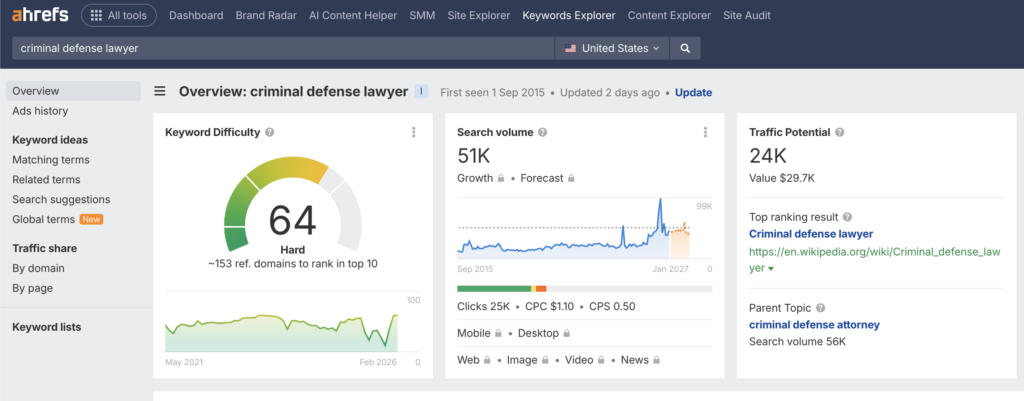
Use free tools like Google Keyword Planner, Google Trends, and AnswerThePublic to identify common searches. For serious SEO efforts, invest in Ahrefs or SEMrush (around $100-200 monthly) for detailed search volume data, keyword difficulty scores, and competitor analysis capabilities. When reviewing keyword difficulty, newer sites should focus on terms with difficulty scores below 20 before tackling more competitive phrases.
Building Conversion Focused Practice Area Pages
Practice area / dedicated service pages serve as the foundation of your criminal defense SEO strategy. These cornerstone pages target your primary keywords and need to comprehensively address everything a potential client wants to know about their specific charge. Generic criminal defense pages that try to cover everything at once collapse under their own weight and fail to rank for anything meaningful.
Each criminal charge you handle should have a dedicated practice area page that speaks directly to someone facing that specific charge. A DUI page should feel completely different from a domestic violence page or theft defense page because the concerns, stakes, and questions are different for each charge.
Structure these pages to match how stressed people actually read. Open with immediate relevance by acknowledging the specific charge and why it matters without any history lessons or firm introductions. Someone searching for help with an assault charge wants to know right away that you understand their situation and can help. Save the selling until after you’ve established credibility through education.
Right after the fold (top section of the page), make sure to have some sort of trust factor (reviews, testimonials, case stats, etc.) After this, we have found sections specifically addressing each individual charge within the practice gets quite a bit of attention.
After these sections, then you can dive into the more specific details like explaining what the law says, how charges are typically filed, what penalties may apply, and what factors make cases more or less serious. Only after building this foundation should you shift toward defense strategy and why hiring an attorney matters. This order shows respect for the reader’s state of mind and builds trust through clarity rather than marketing speak.
Target 1,500 to 3,000+ words for each practice area page, but avoid fluff for the sake of word count. Every paragraph should serve a purpose by answering questions, correcting misconceptions, or explaining processes. Break up text with subheadings every 300-400 words, use short paragraphs, and incorporate bullet points when listing penalties, potential defenses, or steps in the legal process.
Include your target keyword naturally in the first 100 words, in at least one subheading, and sprinkled throughout the content where it flows naturally. Never force awkward phrasing just to include keywords. Google’s algorithms have become sophisticated enough to understand context and penalize obviously keyword-stuffed content.
Add clear calls-to-action throughout the page, not just at the bottom. After explaining penalties, remind readers that an attorney can help reduce charges. After discussing the legal process, offer a free consultation to discuss their specific situation. Make it easy to call you with prominent phone numbers and click-to-call functionality on mobile devices.
Writing Educational SEO Content to Build Authority
Blog content serves multiple purposes in your criminal defense SEO strategy. Educational articles attract traffic from informational searches, establish your expertise on specific legal topics, answer common questions potential clients have, and provide shareable resources that can earn backlinks from other websites.
The key to effective criminal defense blog content is matching search intent while providing genuine value. Someone searching “what happens at a criminal arraignment” doesn’t want a sales pitch. They want clear, accurate information about what to expect during this intimidating process. Provide that information first, then mention at the end that having an attorney can help navigate the process more smoothly.
To optimize your blog content for AI (AEO), offer a clear and succinct answer to the root question at hand right away in the introduction. The easier you can make it for AI to regurgitate the content as its own, the better you will rank for AI overviews.
Note: While some might not want AI to be stealing the content you worked so hard to make, it’s going to take it from somewhere, so you might as well serve it up on a platter and hope the reader clicks on the link to learn more.
Common blog topics for criminal defense attorneys include explanations of legal processes (arraignments, preliminary hearings, plea negotiations, trials), breakdowns of how specific charges work in your jurisdiction, discussions of recent legal changes that affect criminal cases, advice for what to do immediately after arrest, explanations of constitutional rights, and answers to frequently asked questions from consultations.
Write blog content at a reading level your clients can easily understand. Avoid legal jargon unless you provide clear explanations. Structure articles with descriptive subheadings that allow readers to scan for the information they need. Include relevant internal links to related blog posts and practice area pages to keep readers on your site longer and distribute link equity throughout your website.
When it comes to the frequency of posting content, always focus on quality over quantity. Aim to publish one to two quality blog posts monthly rather than rushing out mediocre content weekly. Quality legal content typically requires three to five hours per post to research properly, write clearly, and optimize effectively. If you don’t have time to maintain consistent publication, prioritize practice area page optimization over blog content.
Most importantly, target your SEO content towards the clients you want to have. If you’re unhappy with your current clientele, target a different demographic and adjust your SEO strategy accordingly.
Mastering Local SEO and Google Business Profile
Local SEO delivers exceptional ROI for criminal defense attorneys because searches with local intent indicate immediate hiring need. When someone searches for “criminal defense lawyer near me” or “DUI attorney [city],” they’re ready to call an attorney right now. Google displays local results prominently in the Map Pack, which appears above traditional organic results and captures approximately 42% of clicks from local searches.
Your Google Business Profile serves as your digital storefront and often provides a potential client’s first impression of your firm. Claim and verify your profile immediately if you haven’t already. Choose the most specific primary category for your main practice area. “Criminal Justice Attorney” performs better than generic “Legal Services” because it directly matches searcher intent for criminal defense representation.
Complete every section of your profile with accurate information. Use your legal business name without adding keywords or locations (Google penalizes keyword-stuffed business names). Ensure your address and phone number match your website exactly. Write a compelling description that naturally incorporates relevant keywords while explaining what makes your firm different.
Add professional photos of your office, team, and yourself. Google has confirmed that businesses with photos receive significantly more website clicks than those without. Include exterior building shots, reception area, consultation rooms, and professional headshots of all attorneys. Update photos regularly to keep your profile fresh.
The services section allows detailed descriptions of each criminal charge you handle. Write unique descriptions for each service, incorporate relevant keywords naturally, and add an image for each service category. This section provides additional real estate for keyword optimization while helping potential clients quickly identify whether you handle their specific charge.
Post regular updates to keep your profile active and engaging. Share news about case wins (without revealing confidential details), changes in local criminal laws, community involvement, or legal tips.
There is also an option for Q&As. Have a member of your team (or just a separate Google account), ask questions that you would like to publicly answer. Then go through and answer all of the questions (bonus points if you naturally work in keywords). Google favors active profiles when determining local rankings, and regular posts show potential clients that your firm stays current and engaged.

The Critical Importance of Reviews
Online reviews significantly impact both your local search rankings and conversion rates. Research consistently shows that over 90% of consumers read online reviews before making decisions, and this percentage is even higher for high-stakes decisions like hiring a criminal defense attorney. Law firms with 50+ Google reviews and ratings above 4.5 stars substantially outperform competitors in both visibility and trust.
Develop a systematic process for requesting reviews from satisfied clients. The best time to ask is shortly after a successful case resolution when clients feel most grateful and relieved. Make the process as easy as possible by sending direct links to your Google review page via email or text message. Never offer incentives for reviews, as this violates Google’s policies and can result in penalties.
Pro Tip: Add a redirect on your website from /review/ to point directly to your Google Business Profile review link. This makes it significantly easier to lead clients to the right place. You can also add a button with this link on your website to add another option to direct clients.
Respond to every review professionally and promptly. Thank positive reviewers specifically for their kind words and mention something unique about their experience when possible without revealing confidential information. This shows potential clients that you value feedback and pay attention to client satisfaction.
Negative reviews are inevitable, particularly in criminal defense where outcomes sometimes don’t always meet client expectations. Respond to negative reviews by acknowledging the reviewer’s concerns, apologizing for their dissatisfaction, and offering to discuss their concerns offline. Never argue publicly, reveal confidential information, or get defensive. How you handle criticism shows character and professionalism that potential clients notice.
Remember that a perfect 5.0 rating actually raises suspicion among savvy consumers. A few negative reviews among many positive ones demonstrates authenticity. Focus on maintaining a strong overall rating while addressing legitimate concerns constructively.
Technical SEO Fundamentals
Technical SEO ensures search engines can properly crawl, index, and understand your criminal defense website. While you don’t need to become a developer, understanding these fundamentals helps you identify issues that could be undermining your content and optimization efforts.
The first thing you need to check if you have a new website is if it is indexable. WordPress often defaults to “discourage search engines from crawling”. This is great when you’re building a site, but will leave you invisible if you forget to turn it off. This section looks a little different based on your CMS, but please triple check to make sure your site is indexable. A great way to check this is to paste your URL into the top search bar of Google Search Console it will tell you if it’s readable.
Google uses mobile-first indexing, meaning it primarily evaluates your website’s mobile version when determining rankings. Your site must be fully responsive across all device sizes, load in under three seconds on mobile devices, feature easily tappable buttons and phone numbers, display readable text without zooming, and prioritize prominent click-to-call functionality since most criminal defense clients search from mobile devices.
Site speed directly impacts both rankings and conversion rates. Research shows that 53% of mobile users abandon sites that take longer than three seconds to load. The biggest culprits for slow criminal defense websites are oversized images. Keep all images under 300KB, use JPG or WebP formats (only PNG when you need transparent backgrounds), and resize images to their actual display dimensions before uploading.
Your website must have an SSL certificate (the “https” in your URL) which encrypts data transmitted between your site and visitors. This is essential for contact forms where potential clients share sensitive information about their charges and circumstances. SSL is also a confirmed ranking factor and browsers often display warning messages for sites without proper security certificates.
Schema markup helps search engines understand your content and can result in enhanced search displays called rich snippets. For criminal defense lawyers, implement LocalBusiness schema, Attorney schema, LegalService schema for each practice area, and FAQPage schema for your frequently asked questions. WordPress plugins like RankMath include schema generators that make implementation straightforward without requiring coding knowledge.
Internal linking helps search engines understand your site structure and distributes ranking power throughout your pages. Every page should have at least one link pointing to it from elsewhere on your site. Orphaned pages without incoming links are nearly impossible to rank. Link related blog posts to each other and to relevant practice area pages using descriptive anchor text that includes relevant keywords when natural.
Link Building for Criminal Defense Lawyers
Backlinks from other websites remain among Google’s most important ranking factors because they signal that other sites consider your content valuable enough to reference. When building links, quality matters exponentially more than quantity. A single link from a respected legal publication or local news site carries more weight than dozens of links from low-quality directories.
Start building your link profile by completing listings on legal directories like Avvo, Justia, FindLaw, Martindale-Hubbell, and Lawyers.com. While these directories have become somewhat commoditized, they still provide valuable backlinks from high-authority legal websites. Ensure your profile information matches your website exactly, particularly your name, address, and phone number.
Join local and state bar associations, which typically include member directories with links to member websites. These association links carry significant weight because they come from authoritative legal organizations. Participate actively in bar association activities, committee work, and continuing legal education to maximize the value of your membership beyond just the directory link.
Local citations from general business directories like Yelp, Bing Places, Apple Maps, Better Business Bureau, and your local Chamber of Commerce strengthen local SEO signals. Consistency across these citations matters more than volume. Small variations in how your name, address, or phone number appear can confuse search engines and dilute local ranking signals.
Contribute guest articles to legal publications, local news outlets, and industry blogs. This requires significant time investment but delivers high-quality backlinks and positions you as a thought leader. Respond to journalist queries through platforms like HARO (Help a Reporter Out) to earn mentions and links from news sites covering criminal justice topics.
Build relationships with complementary legal practices that handle different practice areas. An estate planning attorney or family lawyer in your area might be willing to link to your criminal defense services in exchange for reciprocal links. Avoid obvious link exchanges with direct competitors, but strategic relationships with non-competing attorneys can benefit everyone.
Warning: Never purchase links unless you have extensive SEO experience and understand the risks. Google explicitly prohibits buying links, and low-quality purchased links can trigger severe penalties that are difficult to recover from. This is particularly important for criminal defense websites since you already face stricter evaluation standards under YMYL guidelines.
Citations and NAP Consistency
NAP (Name, Address, Phone Number) consistency might seem like a minor technical detail, but inconsistencies across the web can significantly harm your local search rankings. Search engines use NAP information to verify your business exists and operates at the location you claim. Conflicting information creates confusion and erodes trust in your listing accuracy.
Your NAP should be identical everywhere it appears online, including your website footer and contact page, Google Business Profile, legal directories, social media profiles, and local business listings. Small variations like “Street” versus “St.” generally don’t cause problems, but avoid abbreviating your business name differently across platforms or listing multiple phone numbers without explanation.
Audit your existing citations quarterly to catch and correct inconsistencies. Search for your firm name, phone number, and address variations to identify where your information appears. If you’ve moved offices or changed phone numbers, update every citation promptly. Old, outdated information that remains online can confuse both search engines and potential clients trying to contact you.
Services like Whitespark offer citation building and cleanup for law firms that don’t have time to build citations manually. While paid services cost several hundred dollars, they save significant time and ensure consistency across hundreds of directories simultaneously.
Content Strategy and Publication Consistency
Publishing random, sporadic content won’t build the topical authority needed to compete in criminal defense SEO. A documented content strategy outlines what content you’ll produce over the coming months, when you’ll publish it, and what keywords each piece targets. This helps maintain the quality and consistency necessary to outrank other defense firms.
Start by creating a simple spreadsheet with columns for publish date, post title, post type (blog, practice area page, upgrade, etc), target word count, primary keyword, keyword difficulty, and keyword search volume. This planning document keeps you organized and ensures you’re targeting the right mix of keywords at appropriate difficulty levels for your current domain authority.
New criminal defense websites should focus on establishing authority for one primary practice area before expanding to others. If DUI defense represents your most profitable and experienced area, focus on creating content around DUI topics before tackling assault, theft, or drug charges. This focused approach helps Google understand what you specialize in rather than positioning you as a generalist who might not have deep expertise in any particular area.
Prioritize content that answers top-of-funnel questions your ideal clients ask during consultations. These pieces serve multiple purposes beyond SEO, including email campaigns, handouts for current clients, resources for referral sources, and content for social media. Common examples include “What to do after being arrested,” “How to choose a criminal defense lawyer,” “What are your Miranda rights,” and “When can police search your car.”
Consistency matters more than volume. Publishing one high-quality, well-researched article monthly outperforms publishing four rushed, mediocre articles. It’s important to set realistic expectations based on available time and resources. If you can only dedicate five hours monthly to content creation, focus those hours on one exceptional practice area page or blog post rather than trying to publish multiple times.
Understanding Domain Authority and Realistic Timelines
Domain Authority (DA) is a metric used to estimate your website’s strength on a scale of 1 to 100, calculated primarily by the quantity and quality of backlinks pointing to your site. New criminal defense websites start with DA of zero and must build authority gradually through consistent content creation and link acquisition. This is why most law firm SEO strategies take six to twelve months to show significant results. You’re not just optimizing pages; you’re building your entire site’s credibility in Google’s eyes.
Keyword difficulty estimates how challenging it is to rank for specific terms, also scored from 0 to 100. This metric compares the number of competing pages and the authority of sites currently ranking. Your DA determines how competitive you can be with established firms for valuable keywords. New sites need to focus on lower-difficulty terms (typically under 20) where competition is manageable, then expand to more competitive keywords as your authority increases.
It’s important to set realistic expectations at the start of your criminal defense SEO journey. The first three months typically show minimal visible results as search engines crawl and index your new or updated content. Months four through six often bring modest improvements with a few rankings appearing on pages two and three of search results. Significant results typically emerge between months six and twelve as your domain authority increases and content gains traction. Once you are regularly generating traffic, the leads follow.
Established criminal defense firms with existing domain authority can see faster results, but the competitive nature of legal SEO means even strong sites need consistent effort to maintain and improve rankings. The firms that commit to ongoing optimization, regular content creation, and strategic link building are the ones that dominate local markets long-term.
AI Overview and Generative Search Optimization
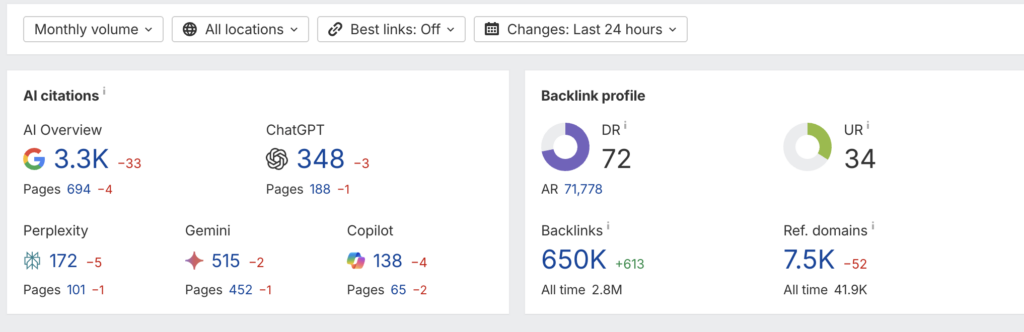
Google’s AI Overviews represent a fundamental shift in how search results display, particularly for informational queries. When someone searches “what to do after DUI arrest,” Google may display an AI-generated summary that answers the question directly at the top of results, pulling information from multiple sources. This development makes traditional first-page rankings less valuable if your content isn’t cited in AI Overviews.
Optimizing for AI-powered search is fairly simple. Focus on writing in natural, conversational language that directly answers questions. In addition to optimizing for keywords and phrases like “criminal defense attorney,” create content that answers real questions like “Do I need a lawyer for a misdemeanor charge?” or “How soon should I hire an attorney after arrest?” Answer these questions in a clear and succinct manner in the beginning of your article (first 10%) and you will be in a strong position to rank in an AI Overview.
To further optimize for AI, make sure to structure content with a clear hierarchy using descriptive headings that answer specific questions. AI systems favor content that’s easy to parse and extract specific answers from. Break complex topics into digestible sections with clear subheadings that could stand alone as answers to specific queries.
Focus on expertise, experience, and trustworthiness signals that AI systems use to evaluate source credibility. This includes author credentials clearly displayed, publication dates on articles, citations to authoritative sources, and comprehensive coverage of topics rather than superficial overviews.
In layman’s terms, make your content easy for AI to steal. If you wrap it up in a nice package with a bow on top, you’ll see rankings improve quickly. Remember, the goal of securing higher rankings for blog articles is to build topical authority. None of this information is ground breaking so serve it up nicely and reap the benefits when Google deems you as the “expert” in your field.
Conversion Rate Optimization for Criminal Defense Law Firms
Ranking on page one means nothing if visitors don’t convert into consultations and clients. Criminal defense conversion optimization focuses on reducing friction and building trust rapidly since potential clients are making urgent decisions under stress.
Your homepage should immediately communicate who you are, what you do, and where you practice. Someone landing on your site from a search for “DUI lawyer [city]” should see clear confirmation they’ve found the right place within three seconds. Display your primary practice areas prominently, include your service area clearly, and feature your phone number in the header of every page.
Make it easy to contact you through multiple channels. Display your phone number prominently with click-to-call functionality on mobile devices. Include a simple contact form on every practice area page, not just a dedicated contact page.
You can also offer live chat for immediate questions, which can be useful during evening and weekend hours when arrests commonly occur and people start researching attorneys. However, make sure to properly test these live chats. Whether you choose AI, an outsourced call center, or an in-house representative, make sure they are providing valuable information to potential clients. Live chat functions can do more damage than good if they are scaring away potential clients.
Another effective way of improving conversion rates is to include trust signals throughout your site. Display badges for bar memberships, awards, and professional associations. Feature client testimonials on practice area pages with specific details about the results you achieved. Mention years of experience, number of cases handled, or specialized certifications relevant to criminal defense.
It is also important to use professional photography rather than stock images. Photos of your actual office, real attorneys on your team, and authentic consultation spaces build more trust than generic courthouse or gavel images used on every other law firm website. Potential clients want to know who they’ll be working with, where they’ll meet, and if they can trust you with their case.
For criminal defense, it can help to create a sense of urgency (without being manipulative). Criminal charges have real deadlines and consequences that worsen with delayed action. Explain time-sensitive factors like statute of limitations, evidence preservation, and benefits of early intervention to encourage visitors to contact you. Please make sure to read and re-read any content intended to build urgency to ensure you’re not fear-mongering or presenting misleading information in any way shape or form.

Accurately Measuring Success and ROI
Before implementing any of your SEO strategy, make sure you have the proper tracking in place. Track metrics consistently to understand what’s working and justify continued SEO investment. Focus on meaningful data that connects to business outcomes rather than vanity metrics like clicks and impressions that look impressive but don’t correlate with signed cases.
Note: Click and impressions are useful metrics in the early stages of SEO to show which pages are gaining traction. Once a campaign is solidified, you should focus on lead quantity, conversion rate, and average lifetime value.
Organic traffic from search engines indicates people are finding your site, but traffic alone doesn’t pay the bills. Track which pages receive the most traffic and whether that traffic comes from relevant searches. A spike in traffic from informational blog posts might build brand awareness but may not generate immediate leads.
Keyword rankings show your position for targeted terms, but remember that rankings fluctuate daily and don’t directly equal leads. Track rankings for your most important commercial intent keywords like “[practice area] lawyer [city]” while understanding that being number three instead of number one might not significantly impact results if both positions are on page one.
Conversion rate measures the percentage of site visitors who take desired actions like calling, submitting contact forms, or scheduling consultations. This metric matters more than traffic or rankings because it directly connects to revenue. A site that receives 100 visits monthly and converts 10% generates significantly more value than a site with 500 visits and 1% conversion.
Lead quality determines whether your SEO strategy attracts ideal clients or wastes time on unqualified inquiries. Track where leads come from (attribution), what charges they need help with, and whether they match your ideal client profile. Adjust your content and keyword targeting based on these lead quality patterns.
Signed cases represent the ultimate success metric. Work with your intake team to track which leads turn into paying clients and what marketing sources generated those clients. Calculate your cost per signed case by dividing your monthly SEO investment by cases signed, then compare this to other marketing channels like Google Ads or referrals.

DIY Versus Professional SEO Services
Deciding whether to handle SEO in-house or hire professionals depends on your market competitiveness, available time, budget constraints, and comfort level with digital marketing.
Handle SEO in-house if you operate in a less competitive market where established firms don’t dominate search results, have 10 to 15+ hours monthly to dedicate to SEO activities, enjoy learning digital marketing and see it as a valuable skill, and have a limited budget for outsourcing but can invest your own time.
Hire professional SEO services if you practice in a major city with intense competition, your billable rate exceeds the cost of SEO services making your time better spent on casework, you need faster results than DIY efforts typically produce, and you don’t have time to stay current on algorithm updates and best practices.
Quality legal SEO services typically cost $3,000 to $5,000+ monthly depending on market competitiveness and scope of work. Agencies offering “complete SEO” for under $1,000 monthly usually deliver templated strategies and pre-written articles that won’t produce results in competitive criminal defense markets. Just like lawyers, you typically get what you pay for.
Choosing the Right SEO Partner
If you decide to hire an agency, choose carefully since bad SEO can damage your site for months or years. Look for agencies with specific legal industry experience who understand YMYL requirements and how to optimize criminal defense content effectively. Generic marketing agencies often lack the specialized knowledge needed to succeed in legal SEO (not to mention they could get you in trouble for breaking state Bar regulations).
Quality agencies should be completely transparent about their strategies and results. They’ll provide monthly reports showing keyword rankings, traffic growth, leads generated, and progress toward goals. Be immediately skeptical of agencies that refuse to share data or explain their methods. You’re paying for the service and deserve complete transparency.
Run from agencies that guarantee specific rankings or promise “#1 position in 30 days.” No legitimate agency can guarantee rankings because Google’s algorithm considers hundreds of factors and changes constantly. Agencies making specific promises are either lying or planning to use risky techniques that could get your site penalized.
Ask detailed questions about their approach to content creation, link building, and technical optimization. Quality agencies should be able to explain their strategies in plain language and provide examples of results they’ve achieved for other criminal defense firms.
It’s also important to understand the difference between leads and signed cases. Many agencies proudly report contact form submissions and phone calls as success metrics, but what matters most is whether those leads turn into paying clients. Work with agencies that focus on lead quality and optimize for conversions rather than vanity metrics that don’t translate to business growth.
Getting Started With Criminal Defense SEO
Let’s be honest, if you can survive law school and pass the BAR, you can learn and implement an effective SEO strategy. But the problem isn’t whether you can, it’s whether you have the time to actually do it. Many criminal defense attorneys understand the importance of SEO, but simply lack the time necessary to use it effectively.
This is where we come in. Our team at Lucerna Law Firm Marketing specializes in SEO, Google Ads, and website design specifically for law firms. We understand the unique challenges criminal defense attorneys face, from competing with massive firms to finding time to answer client emails. Our team is here to take marketing off of your plate so you can focus on doing what you do best.
If you’re looking for a dedicated team of law firm marketing professionals who have the knowledge and experience necessary to grow your firm, Lucerna is here to help. Contact us today to learn more.